How to Choose a Bandsaw replaceable segment: A Thorough Explanation of Material, Blade Type, Pitch, and Break-in Period
The selection of band saw replaceable segment is a crucial factor in determining processing efficiency and production costs. Choosing the right replaceable segment not only improves cutting quality of stainless steel and difficult-to-cut materials, but also directly leads to reduced downtime due to longer blade life and maximizes cost performance. This article explains everything from the basic structure of band saw replaceable segment to selection criteria and specific methods for extending blade life, based on expert knowledge.
Table of contents [hidden]
- 1.Structure of a band saw replaceable segment and names of its parts
- 2.Items to check before choosing a replacement band saw replaceable segment.
- 2.1.Check the material and shape of the material to be cutting.
- 2.2.Check the specifications (length, width, and thickness) of replaceable segment that are compatible with the band saw.
- 3.Differences in blade materials | How to choose between M42 and M51
- 4.How to choose the pitch | The number of cutting edges that enter the material cross-section is important.
- 5.Compare based on the cost per cut, not the price of replaceable segment.
- 6.Causes and solutions for premature blade wear
- 7.Break-in period is crucial for the lifespan of new blades.
- 8.Summary
Structure of a band saw replaceable segment and names of its parts
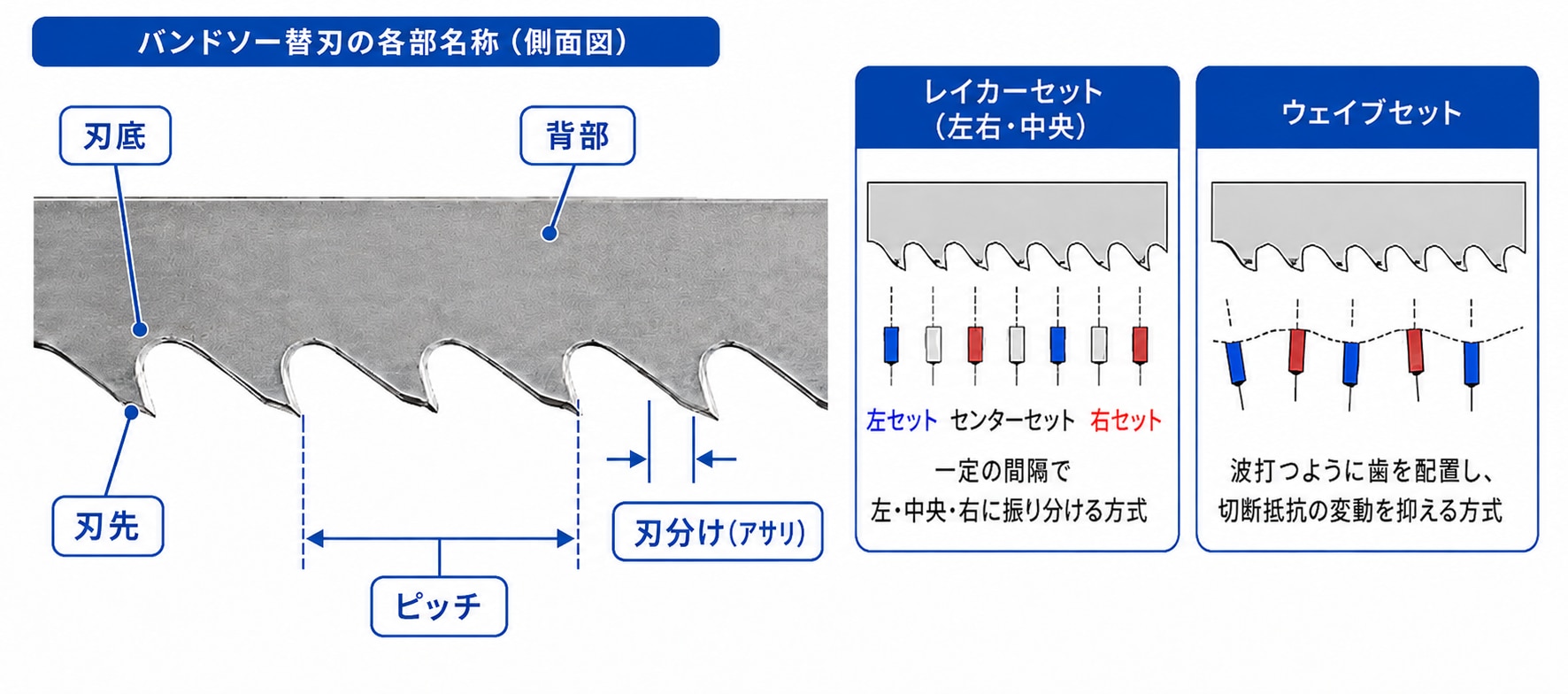
Band saw replaceable segment are not simply metal strips with serrations; they are manufactured based on advanced metallurgical techniques and design theories.
Arrangements of the blades (clams) include the raker set, which distributes them to the left, right, and center at regular intervals, and the wave set, which arranges them in a wave-like pattern.
- Cutting edge: The part that actually cuts away material. High-hardness materials such as high-speed steel or cemented carbide are used.
- Back: A strip of steel that supports the blade. It requires excellent flexibility and fatigue strength to withstand the tensile force from high-speed rotation and the pressing force during cutting.
- Blade base: The recessed area between the blades. It plays an important role in temporarily holding the chips generated during cutting and expelling them from cutting area.
- Pitch: A number indicating how many teeth there are in one inch (25.4 mm).
- Blade splitting: A process that tilts the blades to the left and right so that cutting width is wider than the blade's thickness. This prevents the blade from getting stuck in the material and becoming immobile.
Items to check before choosing a replacement band saw replaceable segment.
To select the optimal band saw replaceable segment, it is necessary to properly organize the specifications of the workpiece and the machine to be used in advance. Standardizing the selection process can prevent rework and incorrect orders, and ensure stable processing quality.
Check the material and shape of the material to be cutting.
The first thing to check is the properties of the material to cutting (workpiece).
Material:The required blade material and cutting speed vary greatly depending on the material.
(Examples) Carbon steel (SS material, SC material), stainless steel (SUS304, SUS316, etc.), aluminum alloy, brass, titanium, nickel-based alloy (Inconel, etc.)
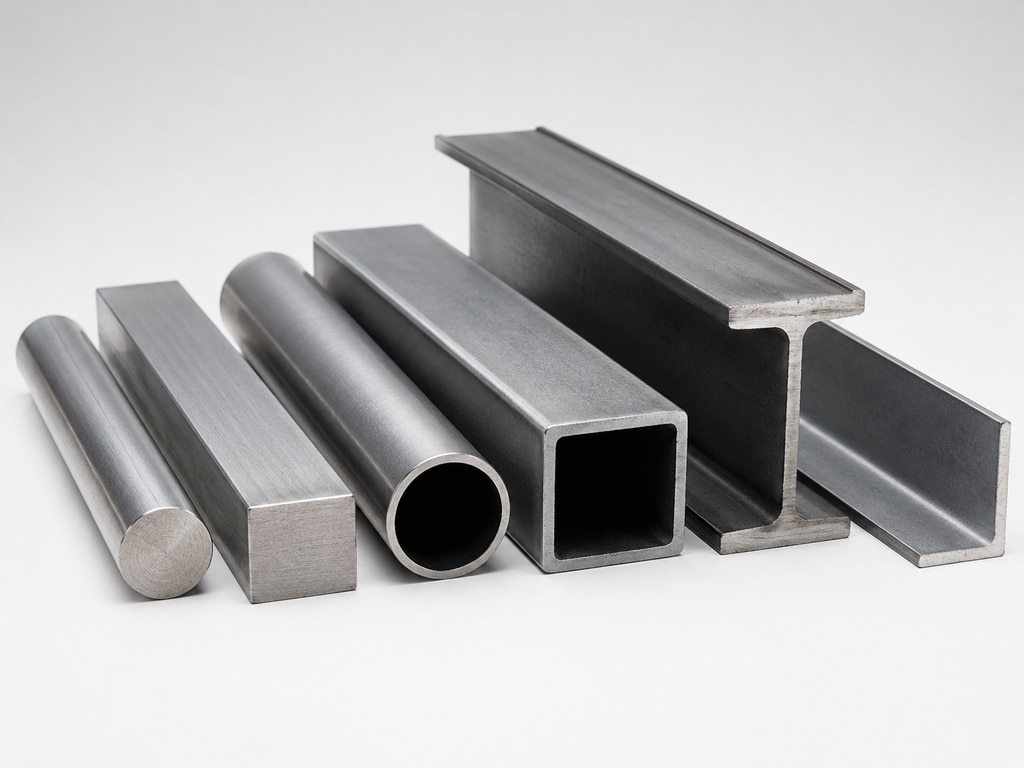
Shape:Because the length of contact between the blade and solid wood differs during cutting, it is necessary to select the appropriate blade shape and arrangement for each.
(Examples) Solid wood such as round bars and square timbers, hollow round pipes, square pipes, H-beams, angles
Check the specifications (length, width, and thickness) of replaceable segment that fit your band saw.
The dimensions (length, width, and thickness) of the blades that can be attached are determined by the model of the band saw you are using. Please check the instruction manual or manufacturer's compatibility chart for your specific band saw, such as a portable band saw, cordless band saw, or medium/large band saw cutting machine, to determine the exact size.
If the width is incorrect, the blade may fall off the wheel or cause serpentine cutting. If the thickness is incorrect, the tension cannot be properly applied, increasing the risk of blade breakage. In particular, when introducing compatible parts from different manufacturers, it is necessary to pay attention to the difference between millimeters and inches in the standard dimensions.
Differences in blade materials | How to choose between M42 and M51
The selection of the cutting edge determines the replaceable segment lifespan and cutting performance of a band saw. The current mainstream is a bimetal structure with high-speed steel at the edge and spring steel on the back welded using electron beams or similar methods. By using different grades of high-speed steel and higher-grade carbide blades, cost performance can be improved.
Cases where the M42 is suitable
M42 (cobalt high-speed steel) is a cutting tool containing about 8% cobalt, offering high versatility. It combines excellent wear resistance with moderate toughness (toughness), making it suitable for a wide range of workpiece cutting, including carbon steel, tool steel, general stainless steel, and non-ferrous metals. It offers an excellent balance of versatility and cost-effectiveness in cutting of section steel that requires intermittent loads or in sites where many different materials require frequent changes and can be handled with a single blade.
Cases where the M51 is suitable
M51 (high-cobalt high-speed steel) is a higher-grade tool material reinforced with alloying elements such as tungsten. It boasts a high red-hot hardness (strength against cutting heat) and wear resistance exceeding M42. Therefore, it is ideal for continuous high-speed and high-efficiency cutting of hard, heat-prone materials such as high-alloy steel, thick stainless steel, and deposition-hardened alloys. The initial installation cost is higher than M42, but under suitable conditions, longer service life can be expected.
We'll suggest the perfect band saw replaceable segment for your company! The catalog download form takes about 1 minute to complete.
How to choose the right pitch | The number of cutting edges that enter the material cross-section is important.
Selecting the pitch (number of teeth per inch) is just as important, if not more so, than selecting the material, for cutting efficiency and preventing chipping of the band workpiece." If there are too few teeth on the material, the load on each tooth becomes too great, causing chipping. Conversely, if there are too many teeth, chips will clog the bottom of the blade (gullet), generating frictional heat and causing premature wear of the blade tip and meandering cutting.
Selecting the pitch of solid wood
When cutting solid wood such as round rods or square timber, cutting choose the pitch according to the length (diameter or width of the material).
Thick materials: A large amount of chips will be produced, so a blade with a large base and a coarse pitch (small numerical value) is required.
Thin materials: Since there is ample space at the base of the blade, use a blade with a fine pitch (higher numerical value).
In recent years, "variable pitch" (uneven pitch), which combines different pitches, has become the mainstream. This suppresses resonance (chatter) during cutting, achieving both smooth cutting and quiet operation. For example, a standard selection guideline would be a "3/4 variable pitch" for a 100mm diameter solid carbon steel block, and a "4/6 variable pitch" for a block of about 50mm in diameter.
Pitch selection for pipes and structural steel
Unlike solid materials, structural materials such as pipes and H-beams require the blade to repeatedly pass through "thin sections" and "hollow sections" when cutting. Therefore, if the pitch is too coarse, the number of teeth making contact with the material decreases, and the load concentrates on a few teeth. As a result, the blade edge catches strongly on the edge of the material, causing "stripping," where the blade edge chips repeatedly.
The primary selection criterion for hollow materials is "wall thickness." Generally, for thin-walled pipes with a wall thickness of 2 mm or less, extremely fine variable pitches such as "10/14" or "14/18" are used to ensure that at least two to three blades are always engaged with the pipe wall. As the wall thickness increases, the pitch gradually becomes coarser, such as "8/12," "6/10," and "5/8." Even with a large outer diameter, selecting a fine pitch for thin-walled materials helps prevent blade breakage.
Compare the cost per cut, not the price of replaceable segment.
Comparing products solely based on the "purchase price" of individual replaceable segment can undermine factory profitability. What's important is the "total cost per cut." While inexpensive, general-purpose replacement replaceable segment reduce initial costs, they tend to wear out quickly, leading to more frequent replacements. When considering downtime costs for setup changes, rework due to cutting cuts caused by worn blades, and the time and labor costs for secondary processing (such as end-face grinding), using longer-lasting, higher-quality blades, even with a higher initial investment, will reduce overall costs.
For example, consider the following comparison:
- replaceable segment A: 20,000 yen, lifespan 500 cuts20,000 yen ÷ 500 cuts = 40 yen per cut
- replaceable segment B: 26,000 yen, lifespan 1,000 cuts26,000 yen ÷ 1,000 cuts = 26 yen per cut
While replaceable segment B may seem expensive at first glance, if its lifespan is doubled, saw blade cost per cut can be reduced by approximately 35%.
To make a more accurate cost comparison, it is important to evaluate not only the price replaceable segment, but also the following items:
- Time required to change replaceable segment
- Downtime due to machine shutdown
- Labor costs for workers
- cutting time (processing efficiency)
- Defects and rework costs due to reduced cutting accuracy
Selecting replaceable segment based on the total cost per cut, rather than just the purchase price, leads to reduced processing costs and improved productivity.
Causes and solutions for premature blade wear
Problems such as "the blade quickly loses its sharpness even after being replaced with a new one" or "the blade tip chips" are not uncommon in the field. There are reasons for this, and by taking the right measures, it is possible to extend the lifespan of the blade.
phenomenon | cause | countermeasure |
The blade tip chips, or the blade falls out in succession. | The pitch is too coarse, feed is too fast, and the material is not properly secured. | Change to a finer pitch, lower feed, and check the vise and material's secure fastening. |
The blade wears down quickly. | cutting speed is too high, feed is too low and the cutting edge is rubbing against the material surface, or there is insufficient cutting fluid. | Adjust cutting speed and feed to suit the material, and check the supply volume and concentration of the cutting fluid. |
Chips get stuck at the bottom of the blade. | The pitch is too fine, or the chip removal brush is worn or poorly adjusted. | Change to a coarser pitch and adjust or replace the chip removal brush. |
cutting surface is curved, or cut at an angle. | Blade wear, excessive feed, insufficient blade tension, guide wear or improper adjustment. | Replace replaceable segment and check feed, blade tension, and guide condition. |
The blade cracks or breaks in the shaft. | Blade tension is too high, improper adjustment of the wheel, back guide, and side guides. | Adjust the blade tension to the correct level and check the wear and position of the wheel and each guide. |
Burrs and scratches appear on the back of the blade. | The back of the blade is in contact with the wheel flange, and the back guide is worn. | Adjust the wheel position and rear guide, and replace worn parts. |
Break-in period is crucial for the lifespan of new blades.
To maximize the lifespan of band saw replaceable segment, "break-in" is an effective method.
Break-in is a process that uniformly forms a "tiny radius (roundness)" on the extremely sharp edges, thereby increasing the strength of the blade tip.
■ Break-in procedure
- Set the blade cutting speed to 70% of the normal value and feed rate (cutting pressure) to 50% of the normal value.
- When cutting solid wood, perform a break-in run with cutting area of approximately 300-500 cm² as a guideline. For pipes and structural steel, run for 15 minutes. For carbide blades, run for cutting area of approximately 1500-2000 cm² as a guideline.
- While checking for any unusual noises or vibrations (chatter) during cutting, gradually return to normal Cutting parameter in several stages.
summary
Selecting replaceable segment for band saws is crucial for reducing factory costs and ensuring consistent cutting quality.
Simply matching the blade size (length, width, and thickness) to the machine is not enough; ensuring that the material and shape of workpiece cutting the optimal blade material (M42/M51/carbide), and the appropriate pitch according to the wall thickness and diameter are all essential prerequisites for preventing problems. After installation, setting the correct Cutting parameter, adequate coolant management, and above all, performing a break-in period for new blades will allow you to unlock the full potential of replaceable segment.
In addition to the immediate purchase price, select replaceable segment that minimize the "cost per cut" by extending their lifespan and reducing setup changes, thereby achieving a stable production system.
Please feel free to contact us if you have any questions, such as "I'd like you to select the appropriate replaceable segment" or "I'd like a quote."
You can view the band saw product page here.