
What is a pilot burner? An explanation of its mechanism and how it differs from direct ignition.
Industrial furnaces and combustion equipment such as drying ovens, firing furnaces, and hot air generators use large quantities of fuel gas, making safe ignition essential. The pilot burner is what supports this safe ignition. The pilot burner is an important safety device that reduces the risk of gas buildup and explosion accidents by first creating a small flame (pilot flame) and using that flame to ignite the main burner.
This article provides a clear explanation of what a pilot burner is, how it works, how it differs from direct ignition, and key maintenance points.
Table of contents [hidden]
- 1.What is a pilot burner?
- 2.Mechanism and Components of a Pilot Burner
- 3.Comparison of pilot ignition and direct ignition systems
- 3.1.Advantages of the pilot ignition system
- 3.2.Disadvantages of the pilot ignition system
- 3.3.Advantages of Direct Ignition
- 3.4.Disadvantages of the direct ignition method
- 4.Summary_
What is a pilot burner?
A pilot burner is a small, independent burner that creates a stable, small flame (pilot flame) before supplying fuel gas to the main burner and initiating full-scale combustion. It is designed for industrial applications requiring high durability and precise control of the flow, even in harsh thermal environments and continuous operation.
Instead of attempting to ignite the main burner directly, it first safely ignites and detects a pilot burner with a small heat capacity. Only after confirming the flame of the pilot burner is the main shut-off valve opened. This plays a crucial role in preventing explosions caused by gas buildup or abnormal combustion within the furnace.
Pilot burner mechanism and components
We will take a detailed look at the operation flow and internal structure of a pilot burner to understand how it establishes and maintains safe combustion.
Mechanism for igniting the main burner
① Discharge gases from inside the reactor (pre-purging)
Before ignition, a blower is used to expel the gases from inside the furnace. This is because ignition with residual gases poses a risk of explosion.
② Ignite the pilot burner.
The ignition electrode generates a spark, creating a small pilot flame. This flame serves as the "kindling" that transfers the flame to the main burner.
③ Check the flames
A flame detector (flame rod or UV sensor) confirms that there is actually a fire.
If no flame is detected, gas will not be supplied to the main burner.
④ Ignite the main burner.
Once a normal flame is confirmed, the fuel valve on the main burner opening. The pilot flame then immediately transfers the flame to the main burner, safely transitioning to full combustion. This pilot ignition method involves confirming safety with a small flame before creating a larger one.
Main components of a pilot burner
The pilot burner is constructed with highly reliable, specialized components to ensure long-term stable operation and withstand severe thermal loads.
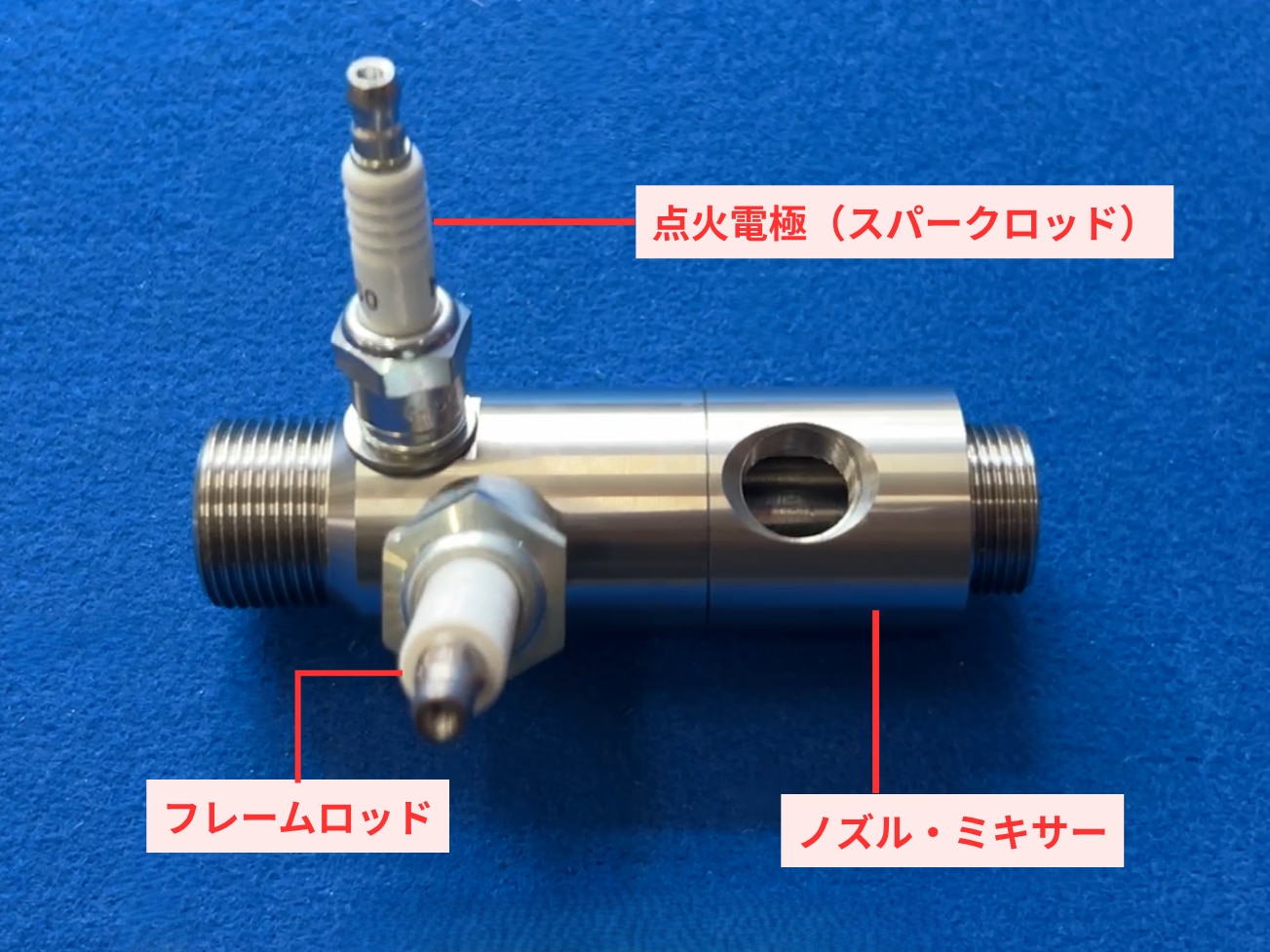
parts | role |
Ignition electrode (spark rod) | It ignites by creating a spark. |
Frame rod | Check if there is a flame. |
nozzle | Injecting gas |
mixer | Mix the gas and air properly. |
Solenoid valve | Controlling the supply and shutoff of gas |
Comparison of pilot ignition and direct ignition systems
When designing new combustion equipment or replacing aging equipment, deciding whether to adopt a pilot ignition system or a direct ignition system is an important consideration.
Both methods have their own advantages and disadvantages, and the appropriate method is selected based on the scale of the equipment, combustion capacity, and safety requirements.
item | Pilot ignition system | Direct ignition system |
How to ignite | Ignition from the pilot flame (kindling) to the main burner. | Direct ignition of the main burner |
safety | It is highly safe because it only proceeds to full combustion after confirming the flame. | While the system is simple, reliable ignition control is crucial. |
Reliability of ignition | Easy to achieve stable ignition | Ignition performance may vary depending on the conditions. |
structure | It has a large number of parts and a complex structure. | The structure is relatively simple |
Implementation and maintenance costs | Initial costs and maintenance parts will increase. | Easy to keep initial costs down |
Advantages of pilot ignition
- It is highly safe because you can see the flame before ignition.
- Even high-capacity burners can be ignited reliably.
- It is well-suited for continuous operation equipment such as industrial furnaces.
Disadvantages of pilot ignition
- The number of parts increases, including pilot burners and flame detectors.
- Initial setup costs and maintenance costs will be somewhat higher.
Advantages of direct ignition
- The structure is simple and equipment costs are easy to keep down.
- It has a small number of parts and is relatively easy to maintain.
- It can perform adequately in small-capacity equipment.
Disadvantages of direct ignition
- In large-scale facilities, managing ignition conditions becomes even more crucial.
- Failure to properly design safety controls increases the risk of ignition failure.
In industrial combustion equipment, pilot ignition systems are frequently used because they facilitate safety control by combining pre-purging, flame monitoring, and interlocks. Selecting the optimal ignition method according to the scale and application of the equipment leads to safe and stable operation.
summary
This article explained the following:
- What is a pilot burner?
- Pilot burner mechanism and components
- Differences from direct ignition systems
By correctly understanding the role of pilot burners and the differences in ignition methods, and selecting specifications appropriate for the equipment, it is possible to achieve a combustion environment that balances safety and stable operation.
If you're unsure about selecting parts for your industrial furnace, please contact us!
If you're having trouble selecting combustion equipment, please leave it to Daido Kogyo!