
What are spark rods and spark plugs? Understanding their mechanism will help prevent gas burner ignition failures.
Industrial gas burners are equipped with an "ignition device" to ignite the gas. However, simply generating high voltage with the ignition device is not enough to ignite the gas. It is the ignition electrode, such as a spark rod or spark plug, that actually generates a spark using that high voltage.
These are not parts you usually see, but they are essential components for a burner to ignite properly.
This time, we will explain the roles, mechanisms, and characteristics of each in an easy-to-understand way.
▼Click here for more information about ignition systems (igniters and ignition transformers)▼
[Related Article] What is an ignition device for industrial gas burners? Comparing the differences between igniters and ignition transformers.
Table of contents [hidden]
- 1.The role and mechanism of spark rods and spark plugs
- 1.1.Why is it necessary? The division of roles with the ignition system.
- 1.2.How Spark Rods and Spark Plugs Work
- 2.[Spark Rod] A versatile ignition electrode with a simple structure.
- 3.[Spark Plug] Ignition electrode with stable ignition performance
- 4.The difference between a spark rod and a spark plug
- 5.Gas burner ignition problems may be caused by deterioration of the spark electrode.
- 5.1.Six signs of deterioration and abnormalities that can lead to ignition failure
- 5.2.Problems that can occur if deterioration is left unattended
- 6.Related parts for spark electrodes that you might also want to know about!
- 6.1.Flame Rod | Safety device for detecting flames
- 6.2.Igniter/Ignition Transformer | A device that generates the high voltage that creates the spark.
- 7.Summary
The role and mechanism of spark rods and spark plugs
To understand the mechanism of ignition, it is necessary to clarify the division of roles between the device that feed electricity (ignition device) and the electrode that actually generates the spark (ignition electrode).
Why is it necessary? The division of roles with the ignition system.
Gas burners are generally ignited using high voltages ranging from several kV to over ten kV. However, the igniter or ignition transformer that generates this high voltage does not directly create a spark in the gas.
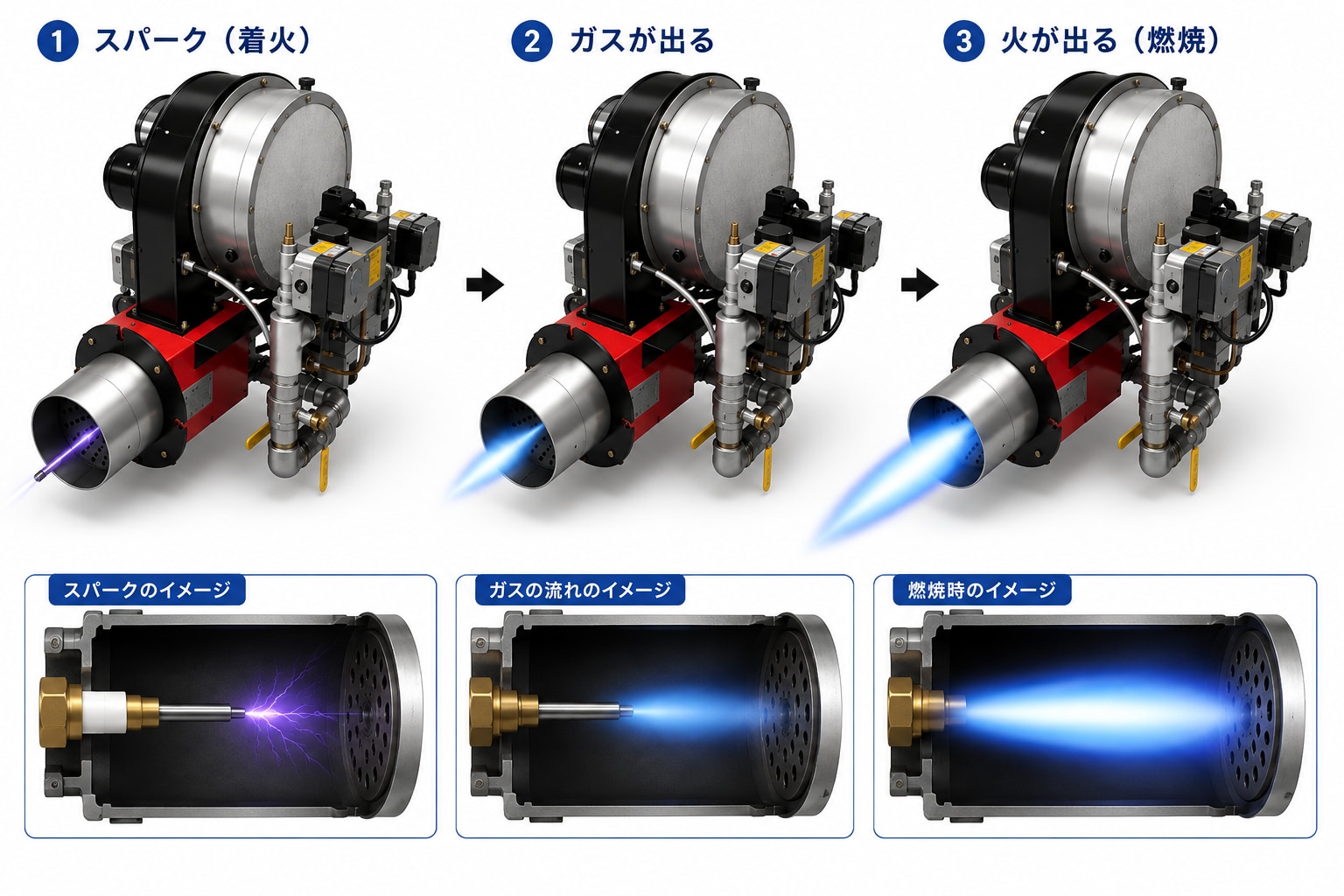
The high voltage generated by the ignition system is sent through a cable to the spark rod and spark plug, where a discharge occurs, generating a spark. The electrodes are positioned appropriately where the gas flows, and combustion begins when the generated spark ignites the gas.
Ignition device (igniter/ignition transformer) = "Its role is to generate the high voltage necessary to produce a spark."
Ignition electrode (spark rod/spark plug) = "Its role is to use the high voltage generated to create a spark near the gas."
As described above, the ignition system and electrodes each have different roles, and both are essential components for reliable ignition. In particular, wear and fouling of the spark rod or spark plug can prevent the spark from being generated properly, which can cause ignition failure or misfires.
How spark rods and spark plugs work
A gap (spark gap) is provided between the tip of the ignition electrode and the metal part opposite it (the ground side) to generate a spark.
When a high voltage is applied, the air in this gap undergoes dielectric breakdown, and the moment it exceeds the limit, electricity jumps through the space as a spark. This is a spark. The energy from the generated spark ignites a mixture of gas and air at the appropriate concentration, and combustion begins.
While household gas stoves also utilize a similar discharge principle for ignition, industrial gas burners require heat resistance, durability, and reliable ignition performance tailored to the operating environment and combustion conditions.
[Spark Rod] A versatile ignition electrode with a simple structure.
Spark rods, widely used in industrial gas burners and combustion equipment, are versatile electrodes that can be flexibly adapted to different installation environments and designs.
It has a very simple structure in which a metal conductive rod running through the center is encased in a highly heat-resistant ceramic sleeve (insulator).
Features of Spark Rod
- Simple structure and high durabilityIts structure is relatively simple, and with proper usage conditions and regular inspections, it can be used for a long period of time.
- Can accommodate various shapesThe length, tip shape, and bending shape of the spark rod can be designed to match the burner shape and combustion chamber structure, allowing for compatibility with a wide variety of equipment.
- Relatively easy to replaceMany spark rods have a structure that allows for replacement of individual components even if wear or deterioration of the insulator occurs, resulting in excellent maintainability.
- Can be used in high-temperature environmentsBecause it uses a ceramic insulator, it can be used stably even near high-temperature combustion chambers.
- Easy to keep costs downDue to its simple structure, it is relatively inexpensive and easy to adopt.
Recommended for this type of equipment
- Industrial gas burner
- Pilot burner
- Combustion equipment such as drying furnaces, heating furnaces, and heat treatment furnaces
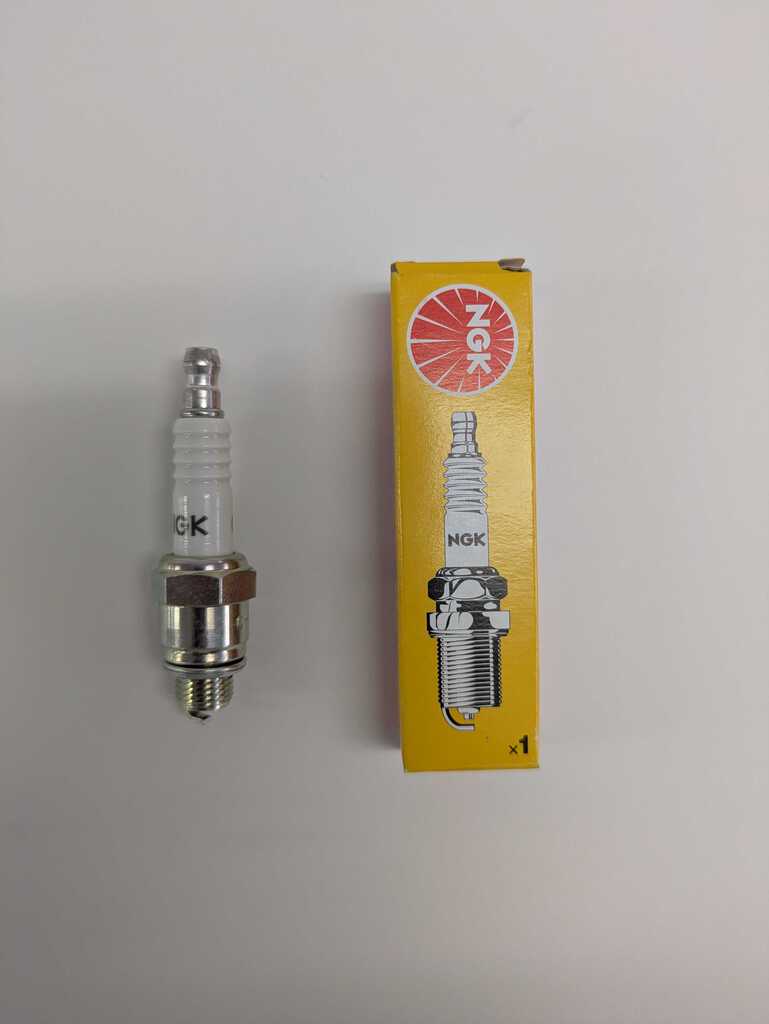
Spark Rod
[Spark Plug] Ignition electrode with stable ignition performance
Spark plugs have a structure in which the insulator and electrode are integrated, and are characterized by their ability to easily generate a spark stably in a predetermined position. Spark plugs are suitable for equipment that requires stable electrode positioning or equipment that requires a certain level of mechanical strength at the mounting point.
Features of spark plugs
- Generates a stable sparkThe gap between the electrodes is easily kept constant, resulting in stable ignition performance.
- High heat resistanceThe ceramic insulator maintains its insulating performance even in high-temperature environments.
- High precision of partsThe electrode position is constant, making it easier to generate sparks under the same conditions each time.
- Stable ignition performanceWith minimal ignition variation, stable combustion initiation can be expected even in continuous operation equipment.
Recommended for this type of equipment
- Gun-type burner
- Industrial furnace
- boiler
- High-power burner
- Continuous operation equipment
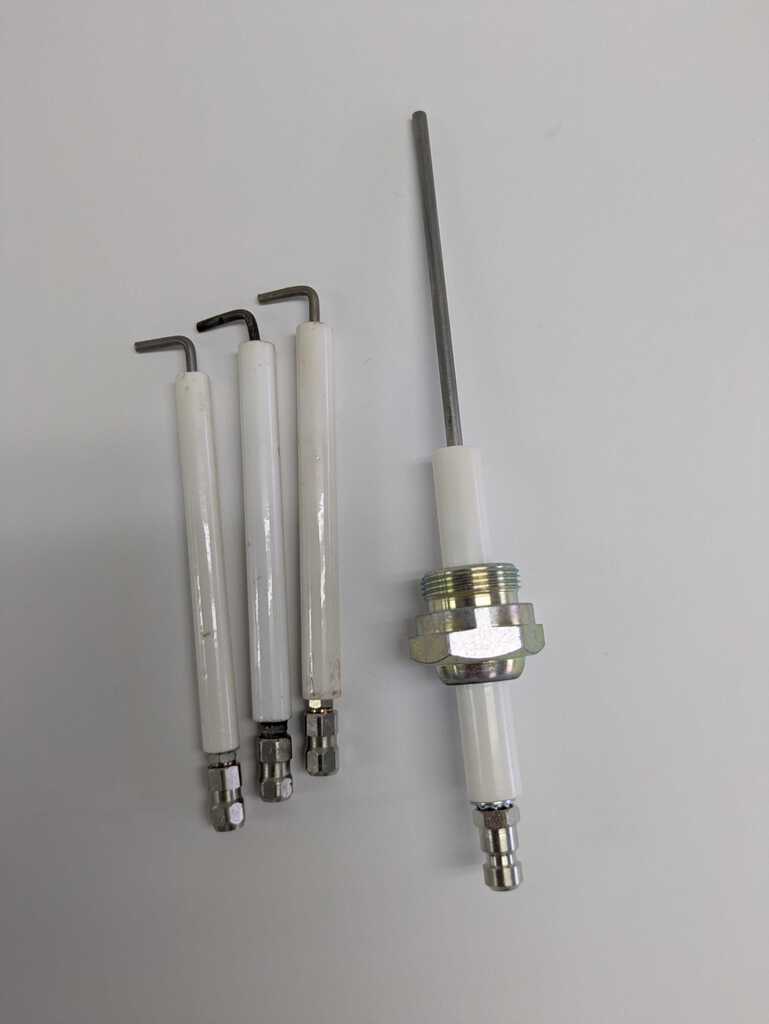
Spark plug
The difference between a spark rod and a spark plug
Both spark rods and spark plugs are ignition electrodes that use high voltage to generate a spark and ignite a gas. However, they differ in structure, installation methods, and the equipment they are suited for.
Spark rods have a relatively simple structure, making them easy to design and manufacture to match the equipment's length and shape. Therefore, they are used in equipment where the electrode position and shape need to be individually set to match the burner structure.
On the other hand, spark plugs have a standardized structure in which the electrodes and insulators are integrated, and are characterized by their ease of stabilizing the position of the electrodes. They are used in equipment that requires resistance to vibration and the surrounding environment, and in burners that require stable ignition performance.
Thus, neither a spark rod nor a spark plug is inherently superior. It is important to select the appropriate ignition electrode depending on the burner's structure, combustion conditions, installation space, and installation environment.
💡For those having trouble selecting ignition systems and combustion equipment💡
Based on factors such as burner capacity, fuel type, installation environment, and operating conditions, Daido Kogyo's Combustion Equipment Division will propose combustion equipment and components suitable for your facility.
We can assist you with the selection of not only ignition systems, but also burners, safety devices, control equipment, and other components.
A gas burner failing to ignite may be caused by deterioration of the spark electrode.
Burner ignition failures can be caused not only by the ignition device itself, but also by wear, contamination, and insulation deterioration of the spark electrode, which is exposed to high temperatures.
Six signs of deterioration or abnormality that can lead to ignition failure
Spark rods and spark plugs are consumable parts. Prolonged use may result in the following symptoms:
- The electrodes wear down and the gap widens.
- Soot and oxides adhere to the surface.
- Cracks appear in the ceramic part.
- The electrodes deform.
- The sparks become weaker.
- The location where the sparks fly shifts.
Problems that can occur if deterioration is left unattended
If you leave these deteriorations unaddressed because "it still works," the following problems may occur.
- It won't ignite.
- It takes time to ignite.
- Repeat the ignition process.
- Ignition becomes unreliable.
To prevent these problems and sudden shutdowns, it is important to maintain a stable combustion state through regular inspections, cleaning, and replacements as needed.
Related parts for spark electrodes that you might also want to know about!
For a gas burner to burn safely and stably, it is crucial that not only the ignition electrode but also various surrounding components work together in coordination.
Understanding the function of these parts will make it easier to pinpoint the cause of problems such as ignition failures.
Flame rod | Safety device for detecting flames
Flame rods have a similar appearance to spark rods and are often installed next to them. Flame rods do not produce sparks; instead, they are safety devices that monitor whether a flame is actually present after the burner has ignited.
The combustion safety controller uses the electrical rectifying effect of a flame (flame rectification) to detect minute currents and determine the presence or absence of a flame. If no flame is detected, the combustion safety controller takes safety actions such as closing the fuel shut-off valve.
When checking for ignition problems, it is important to check not only the ignition system but also the entire combustion safety system, including the flame detection system.
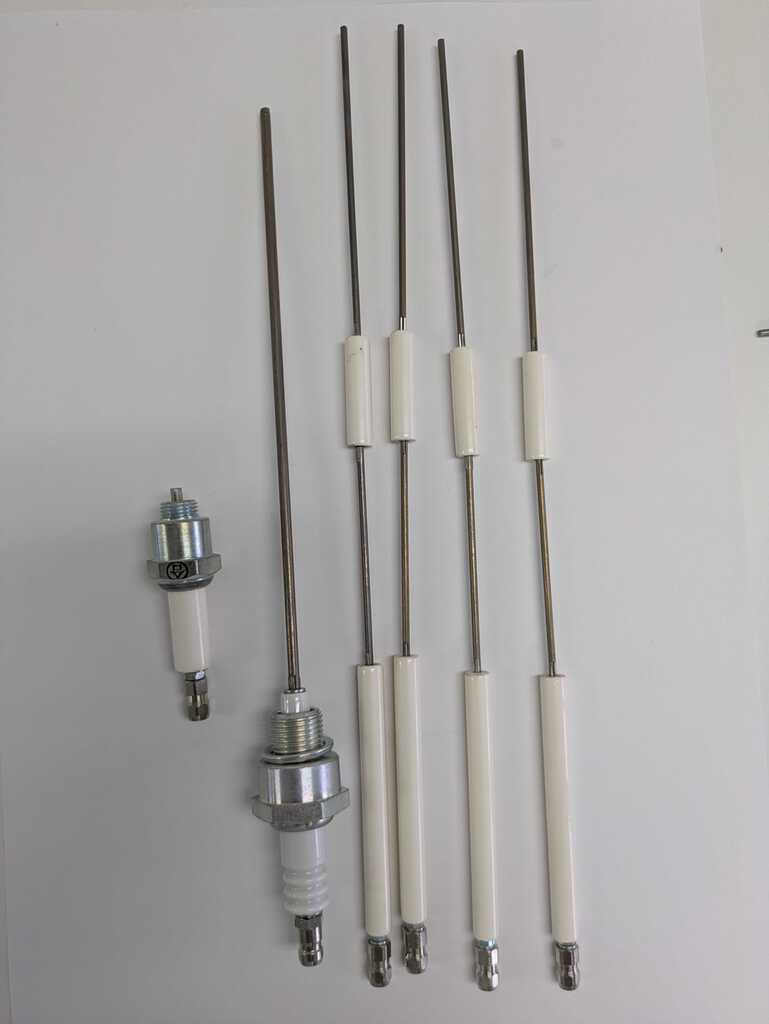
Frame rod
Igniter/Ignition Transformer | A device that generates the high voltage that creates a spark.
The igniter/ignition transformer generates the high voltage necessary to create a spark at the tip of the electrode. It takes a power source such as AC 100V or 200V and generates a high voltage of several kV to over ten kV required for ignition, which is then feed to the ignition electrode via a high-voltage cable.
Therefore, even if there is no problem with the electrodes, if the electronic components inside the igniter are deteriorated or the insulation of the high-voltage cable is deteriorated, the necessary high voltage may not reach the electrodes properly, and a spark may not be generated.
When ignition failure occurs, it is important not only to check the electrodes, but also to check the entire ignition system to ensure that the igniter is generating high voltage correctly, that there is no deterioration or insulation failure in the high-voltage cable's sheathing, and that there are no discharges at the connections.
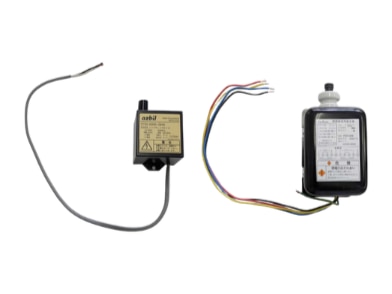
Igniter (left) / Ignition transformer (right)
summary
Spark rods and spark plugs are crucial components that convert the high voltage generated by the ignition system into an actual spark, igniting the gas. Although they may seem like small parts, their condition greatly affects ignition performance, combustion stability, and safe driving.
To prevent ignition failures and misfires, it's important to regularly check not only the ignition system but also the condition of the spark rod and spark plug.
Our company provides support for the inspection and maintenance of industrial gas burners, as well as the selection and replacement of ignition electrodes and combustion safety equipment. Please feel free to contact us if you need assistance with selecting parts suitable for your equipment or if you are experiencing ignition problems.