Causes and countermeasures for stud welding defects
Stud welding is used in a variety of industries, including construction, office equipment, and electrical equipment. Are you a welder or quality control manager struggling with defects in stud welding?
This article aims to solve your problems by explaining the causes of inconsistent stud welding quality and how to address them.
What is stud welding? Click here if you want to learn the basics of stud welding.
[Related Article] What is stud welding? Explanation of basic principles, types, and characteristics
Table of contents [hidden]
- 1.Causes of stud welding defects and immediate countermeasures.
- 1.1.The set voltage is incorrect.
- 1.2.welding force is too strong or too weak.
- 1.3.Poor surface condition of the base material (oil, dirt, rust, coating, plating, paint)
- 1.4.Improper placement or contact of the ground wire.
- 1.5.Insufficient maintenance of the welding gun (wear on the chuck and legs, movement of the shaft)
- 1.6.Incorrect polarity setting
- 1.7.The material and shape of the stud bolts and cap nuts are inappropriate.
- 1.8.There is variation in the depth of the punch (center mark).
- 1.9.Power cable breakage
- 2.Summary
Causes of stud welding defects and immediate countermeasures.
Inconsistent stud welding quality is usually not due to a single cause, but rather a complex interplay of multiple factors. This article focuses on nine major causes of stud welding defects, explaining each cause and providing concrete solutions that can be implemented immediately.
The set voltage is incorrect.
If the voltage is too high, the arc will become excessively strong, causing the base material to melt and burn through, or generating excessive spatter (metal particles like sparks), which can cause burning to spread around the weld.
On the other hand, if the voltage is too low, the arc will not be sufficiently stable, and the stud bolt will not melt sufficiently with the base material. As a result, insufficient penetration will occur, and the stud bolt will not be firmly bonded to the base material, resulting in insufficient strength that will cause it to easily detach during impact bending tests.
The solution is to perform "test welding." It is essential to find the optimal voltage range according to the material and diameter of the stud bolt. Several stud bolts are welded while slightly changing the welding conditions, and impact bending tests are performed each time to identify the optimal conditions.
welding force is too strong or too weak.
If welding force is too strong, the molten pool (pool of molten metal) created by the arc will be pushed outwards from the base material, resulting in insufficient bonding area between the stud bolt and the base material, and thus insufficient strength.
If welding force is too weak, the stud bolt will not sink into the molten pool, resulting in insufficient contact area with the base material and insufficient strength.
We have customer examples where adjusting welding conditions has become easier, improving work efficiency and quality!
Poor surface condition of the base material (oil, dirt, rust, coating, plating, paint)
Oils and paints can burn due to the arc, causing bubbles (blowholes) to form.
Furthermore, the paint acts as an insulator, and in some cases, no arc may be generated at all.
Rust, thick oxide films, and zinc plating have high electrical resistance, which can hinder the arc's rise or cause it to become unstable and jumpy. This can lead to insufficient penetration, increased spatter, and blowhole formation. If air bubbles are present inside, the material will easily break off during impact bending tests.
The grounding wire is not properly installed or has poor contact.
In stud welding, the role of "earthing" is extremely important for supplying a stable welding current. Poor earthing contact or placing the earth extremely far from the welding point increases electrical resistance and causes a voltage drop.
Insufficient maintenance of the welding gun (wear on the chuck and legs, movement of the shaft)
Chuck wear: The chuck can no longer hold the stud bolt securely, causing the threads of the stud bolt to short-circuit.
Leg wear: This can cause the gun's verticality to be compromised, leading to malfunctions.
Shaft movement: Poor movement can lead to insufficient penetration and insufficient strength.
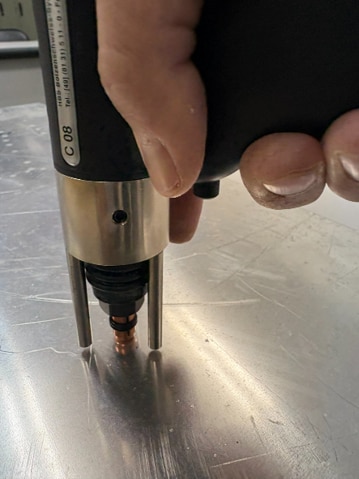
No unevenness in the legs is required, and horizontal alignment is essential.
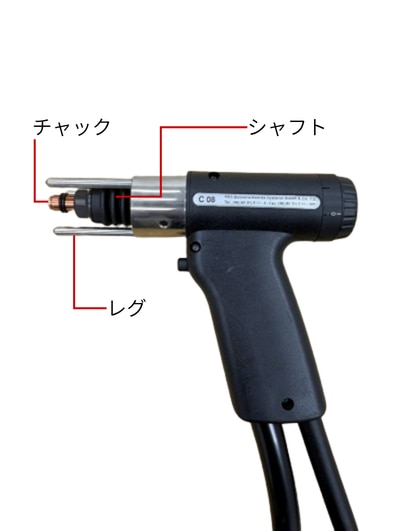
Parts of a welding gun
Incorrect polarity setting
If the polarity is set incorrectly, the material will not penetrate sufficiently, resulting in unstable strength.
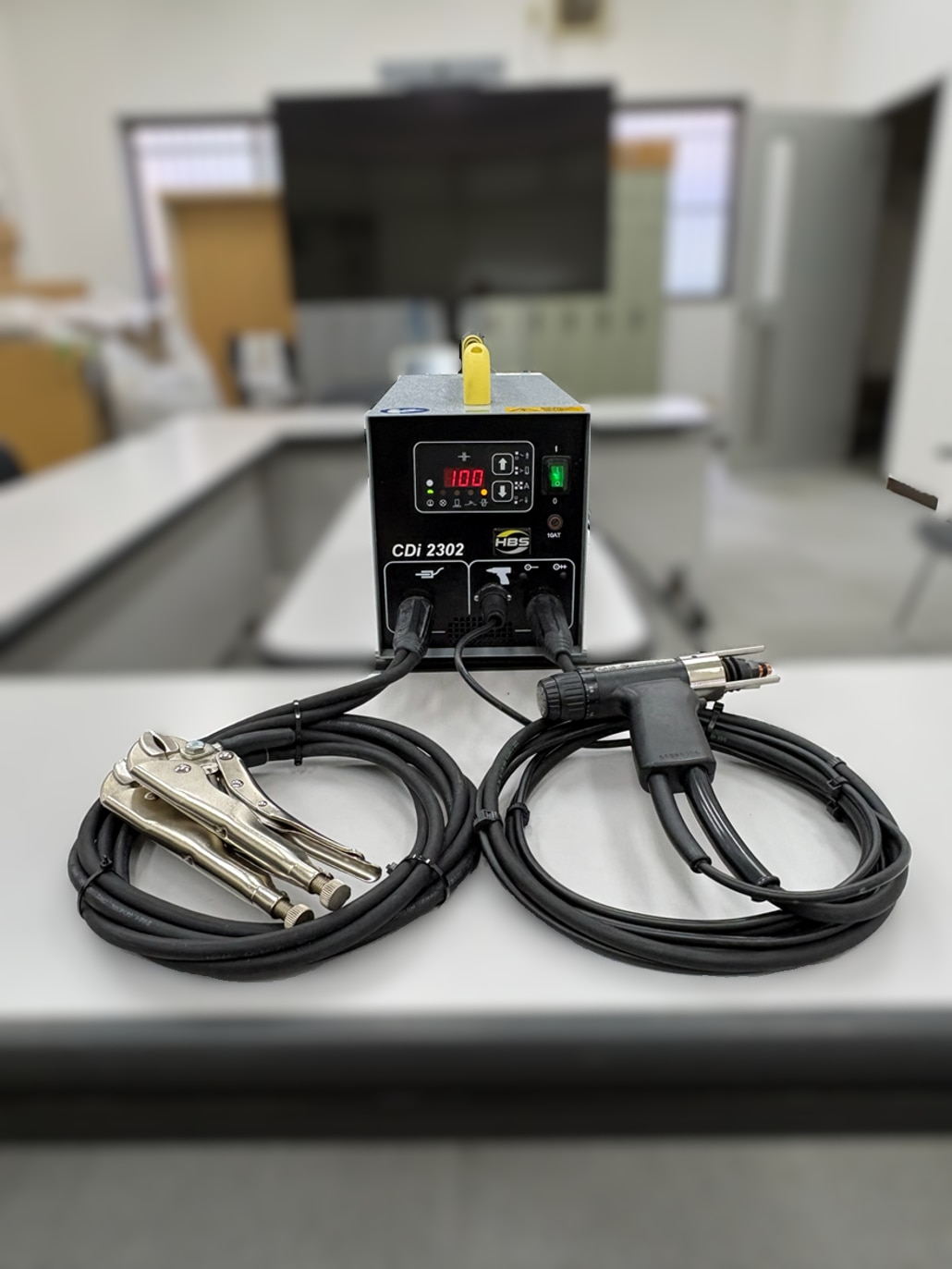
Positive connection (connect the gun to the negative terminal)
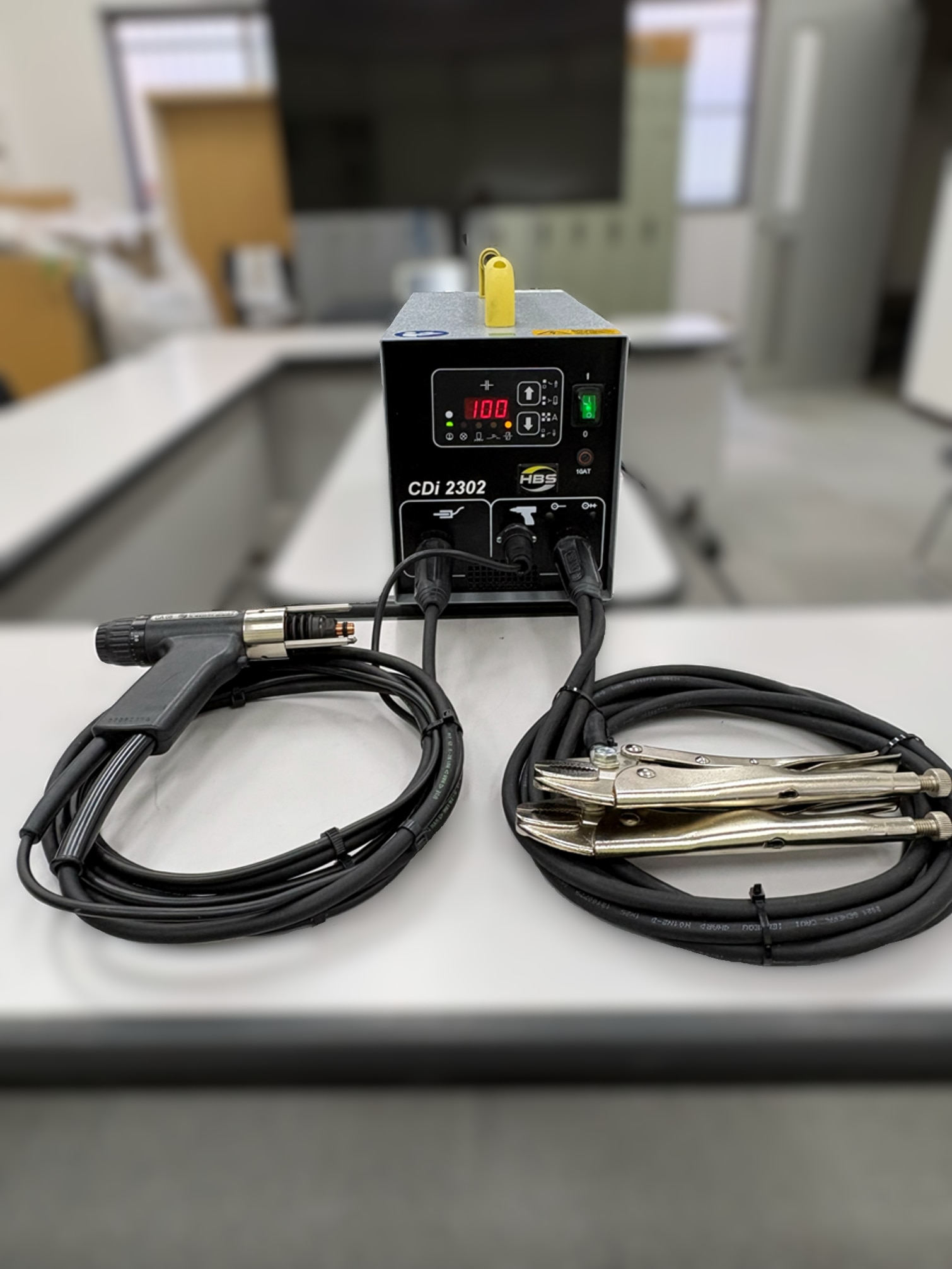
Reverse polarity connection (connect the gun to the positive terminal)
The stud bolts and cap nuts are made of inappropriate material and shape.
The material and shape of the stud bolts significantly affect stud welding, as they can lead to welding defects and reduced weld strength. Please use appropriate studs.
There is variation in the depth of the punch (center mark).
If the positioning punch holes are too deep, the space between the stud and the base material will disappear, resulting in a weak weld.
Power cable broken
Partial breaks within the cable prevent sufficient power from the welding machine from being transmitted to the stud bolts, resulting in an inability to obtain the required voltage. This makes it easier for defects to occur that would cause the impact bending test to fail, even if the welding machine settings are optimized.
summary
This article explains the causes of defects in stud welding and how to address them.
If you have any suggestions for improvement or efficiency improvements in your daily work, please feel free to contact Daido Kogyo.
For those looking for a high-quality stud welder!