What are the risks of direct-fire drying in paint drying ovens? Safety measures and energy-saving effects of hot-air drying.
A paint drying oven is a heat treatment facility designed to efficiently dry products and materials.Direct-fired drying ovens, which introduce flames into the furnace, can pose safety and quality risks, such as ignition of flammable gases, localized overheating, and poor quality of the painted surface.
In recent years, the switch to a hot air system has attracted attention not only because it reduces these risks, but also because it leads to more stable temperature control, reduced exhaust losses, and energy savings.
This article will summarize the risks of direct-fire drying in paint drying ovens, explain the advantages of switching to a hot air method, and describe the differences between direct and indirect hot air methods.
▼Click here if you want to learn about the basic role and importance of drying ovens▼
A thorough explanation of the structure and mechanism of drying ovens | The secret to stabilizing quality
Table of contents [hidden]
- 1.Types of heating methods used in paint drying ovens
- 1.1.Mechanism and characteristics of direct-fire drying
- 1.2.Mechanism and characteristics of hot air drying
- 2.Risks associated with direct flame drying
- 2.1.Legal risks (Article 294 of the Industrial Safety and Health Regulations)
- 2.2.Structural risks
- 2.3.Risks of energy loss and reduced efficiency
- 3.Advantages of switching to a hot air method
- 3.1.Reduction of Explosion and Fire Risk
- 3.2.Reducing the burden of legal compliance
- 3.3.Improving Product Quality
- 4.Differences between direct and indirect hot air systems that you should know when choosing a hot air system.
- 4.1.Mechanism and Advantages of the Direct Hot Air Method
- 4.2.Mechanism and Advantages of the Indirect Hot Air Method
- 4.3.Comparison of Direct Hot Air Method and Indirect Hot Air Method
- 5.Summary_
Types of heating methods used in paint drying ovens
The mechanism and characteristics of direct-fire drying.
Direct-fire drying is a method in which combustion takes place inside a furnace, and the drying process is carried out with the flame exposed to the drying space.
For example, this includes configurations where combustion equipment such as pipe burners are installed at the bottom of the furnace, and the resulting flames and high-temperature combustion gases are applied directly to the material being dried.
Because the inside of the furnace is heated directly by the burner, high temperatures can be reached in a short time. However, with this type of structure, regardless of the type or location of the combustion equipment,the fact that the drying space and the flame are in the same space is problematic from the standpoint of safety and compliance with regulations.
Mechanism and characteristics of hot air drying
Hot air drying is a system in which hot air is generated in a location separate from the drying oven, and drying is performed with the flame completely separated from the drying space.
The main features can be summarized as follows:
① No flames are present inside the furnace, resulting in a low risk of explosion or fire.
② Temperature control is easy, resulting in stable product quality.
③ High level of safety and compliance with laws and regulations
While the equipment costs are slightly higher compared to the direct-fire method, considering the costs and effort involved in safety measures and compliance with regulations, the hot-air method is a more rational choice in the long run.
Risks associated with direct flame drying
Legal risks (Article 294 of the Industrial Safety and Health Regulations)
The safety structure of drying equipment is stipulated in Article 294 of the Industrial Safety and Health Regulations. This article requires that so-called hazardous materials drying equipment be constructed in a way that prevents flames and high-temperature parts from directly affecting the drying material in order to prevent the risk of fire, explosion, etc. The term "hazardous materials" here does not refer to any specific substance names listed in the article.
Therefore, the following applies to all items that pose a fire or explosion risk during the drying process.
① Products that may generate flammable vapors during the drying process.
② Items that may generate flammable gases or dust.
③ Items that pose a risk of ignition, decomposition, or explosion when heated.
Therefore, regardless of the type of material being processed,drying ovens that incorporate flames into the furnaceare highly likely to not comply with current safety standards.
Structural risks
Drying methods that involve flames inside the furnace inherently carry the following risks:
- Localized overheating or ignition of dry materials
- Ignition of flammable vapors and gases
- Quality instability due to variations in temperature distribution
- Reduction in safety margin due to fluctuations in driving conditions
These risks cannot be completely eliminated through operational management alone; they are inherent risks stemming from the equipment structure itself.
If you are considering upgrading from a direct-fired drying oven to a hot-air drying oven, please also check out this product.
Risk of energy loss and reduced efficiency
Direct-fired drying ovens may seem efficient because they heat the inside of the oven directly. However, they can end up using more fuel if a large exhaust volume is required to ensure the safety of the dried material, or if excessive heating is necessary to reduce temperature fluctuations inside the oven.
Furthermore, if it is necessary to adjust the set temperature or processing speed to avoid localized overheating, production efficiency may decrease. When considering energy saving for paint drying ovens, it is important to evaluate not only the simple heating capacity, but also exhaust loss, temperature distribution, heating time, and yield.
Benefits of switching to a hot air method
Switching from direct-fired drying ovens to hot-air drying ovens is effective not only from a safety perspective but also from the standpoint of stabilizing quality and saving energy. Here, we will summarize the main advantages of switching to the hot-air drying oven.
Reduction of explosion and fire risks
In the hot air method, the flame and the furnace cavity are separated. Therefore, situations where flammable gases come into direct contact with the flame are less likely to occur, and the risk of explosion and fire is structurally reduced compared to the direct-fire method.
Reducing the burden of legal compliance
Switching to a hot air systemmakes it easier to reduce the risks associated with structures that introduce flames into the furnace. While the necessary countermeasures will vary depending on the properties of the dry materials, paints, and generated steam and gases, it allows for a structure that is easier to consider in terms of legal compliance and safety measures.
Product quality violation
This eliminates localized overheating of dried materials and contamination of painted surfaces by water vapor and soot generated by combustion. This can lead to a reduction in quality complaints, improved yield, and increased production efficiency.
In terms of safety, legal compliance, and quality, the hot air method far surpasses the direct-fire method. When considering equipment upgrades or new installations, we recommend considering the hot air method as your first choice.
When choosing a hot air method, you should know the difference between direct hot air and indirect hot air methods.
Hot air systems are broadly classified into two types: "direct hot air systems" and "indirect hot air systems."
The mechanism and advantages of the direct hot air method
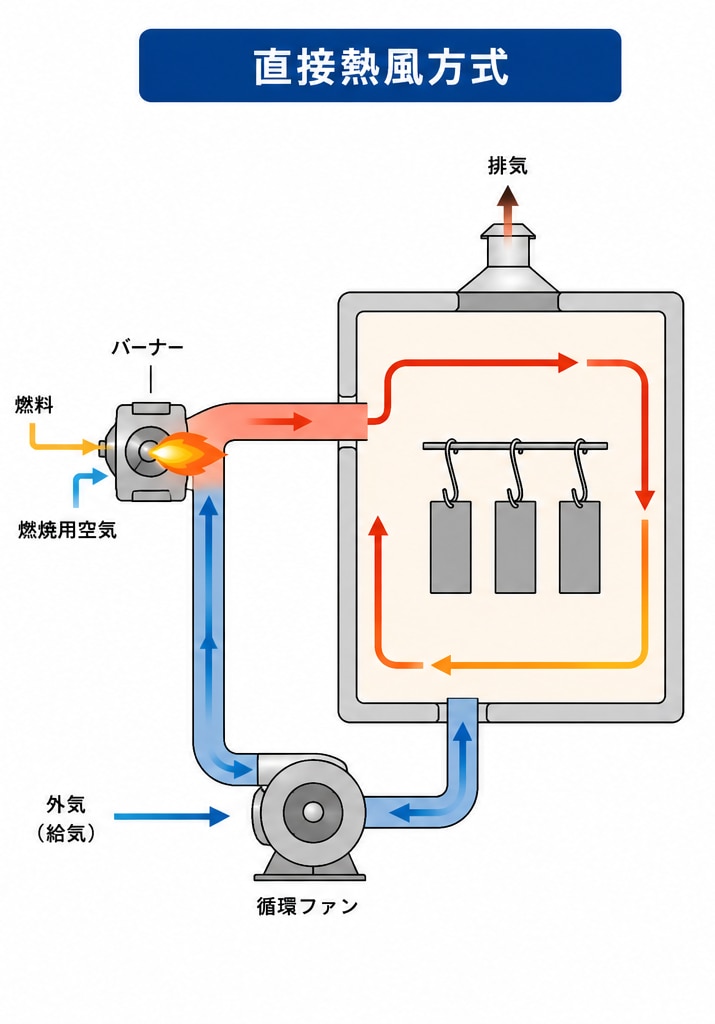
The direct hot air method is a system in which the combustion gases generated by the burner are directly feed into the furnace and circulated as hot air.
【merit】
- It has high thermal efficiency and helps keep energy costs down.
- The equipment structure is relatively simple, which helps to keep installation costs down.
- It excels at heating at high temperatures and allows for quick drying.
Mechanism and benefits of the indirect hot air method
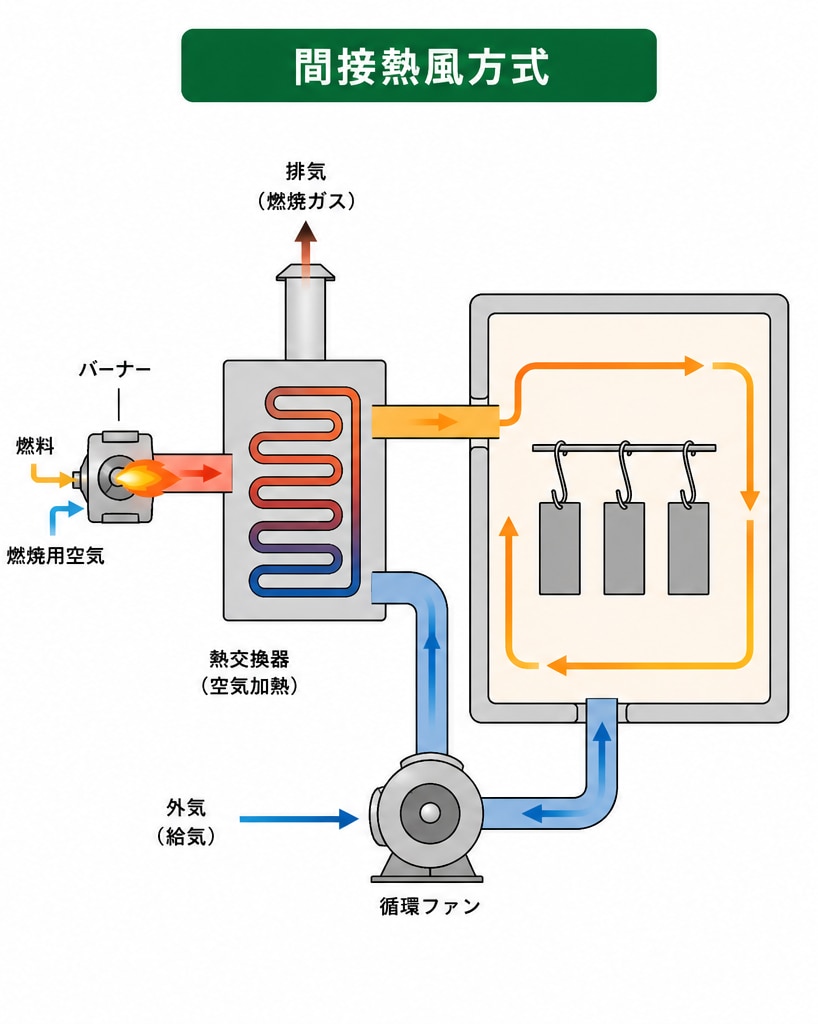
The indirect hot air method heats air through a heat exchanger and circulates only the clean hot air inside the furnace. Since combustion gases do not enter the furnace, the impact on the drying material is minimized.
【merit】
- Because combustion gases do not enter the furnace, the risk of contamination of painted surfaces is extremely low.
- High-quality results can be achieved through uniform heating using clean hot air.
- It is compatible with a wide range of paints, including water-based paints and powder coatings.
- It offers the highest level of safety and is superior from a legal compliance standpoint.
Comparison of direct hot air method and indirect hot air method
Direct hot air method | Indirect hot air method | |
Mechanism of heating | The combustion gas is sent directly into the furnace as hot air. | Clean air heated by a heat exchanger is supplied. |
Impact on painted surfaces | This may affect combustion gases. | No impact |
Energy efficiency | Easy to improve thermal efficiency | There is some heat exchange loss, but it is more robust due to its stable quality. |
Equipment costs | Relatively low | Slightly expensive |
safety | High (a significant improvement over the direct flame method) | higher |
Compatible paints | Solvent-based paints | Solvent-based, water-based, powder |
Suitable uses | Applications where cost is a major consideration and high-temperature drying is required. | Applications requiring high quality and water-based paints. |
Both methods offer advantages over direct-fire drying in terms of safety and quality. When upgrading your equipment, you should actively consider switching to the hot-air method.
▼This article reveals key points for selecting a drying oven▼
A thorough explanation of the structure and mechanism of drying ovens | The secret to stabilizing quality
summary
This article explained the differences between direct-fire and hot-air heating methods for paint drying ovens.
The fundamental challengein paint drying ovenslies not in the difference in heating methods, but in whether or not they are designed to allow flames to enter the oven.
Considering current laws and safety standards, direct-fire drying poses a structurally high risk, making the replacement or installation of hot-air drying ovens the appropriate choice.
At Daido Kogyo, we propose drying ovens and hot air generators that take into account the structure and operating conditions of existing equipment, and comprehensively consider legal compliance, safety, productivity, and energy saving.
If you are considering updating or reviewing your drying equipment, please feel free to contact us for a consultation.
For consultations regarding the risks and energy-saving measures of direct-fired drying ovens, please contact us here.
If you're interested in the hot air method, check out this product!
▼Related articles that are frequently read▼
A thorough explanation of the structure and mechanism of drying ovens | The secret to stabilizing quality