What is a band cutting? A professional explains everything from the basics of metal cutting to safe usage.
cutting saws are widely used cutting cutting metal, but many people may be wondering, "Which model should I choose?" or "What are the differences between a band saw, metal saw blade cutting, and tipped saw blade cutting?" This article will clearly explain the mechanism, types, selection criteria, and safe usage of band cutting.
Table of contents [hidden]
- 1.What is a band saw cutting machine?
- 1.1.How a band saw cutting machine works and how it differs from other cutting machines
- 1.2.Applications of metal cutting that band cutting excel at
- 2.Types of band saw cutting machines
- 2.1.Stationary type
- 2.1.1.Horizontal type
- 2.1.2.Vertical type (contour machine)
- 2.2.Portable Type
- 3.How to choose a metal band cutting
- 4.Correct use of a band cutting and tips for cutting metal.
- 5.Safety measures when using a band saw cutting machine
- 6.Summary_
What is a band cutting (or band saw machine)?
A band cutting is a general term for a machine that cutting materials by continuously circulating a "band-shaped saw blade." The name literally comes from the use of a band-shaped saw blade, and in metalworking, it is sometimes called a "band saw machine."
How a band saw cutting works and how it differs from other cutting machines
A band saw cutting cutting materials by wrapping a strip-shaped saw blade around two large wheels and rotating them continuously in one direction using a motor. Because the saw blade moves in a constant direction, it is easy to achieve stable cutting when conditions are right, and is suitable for large diameter and thick materials.
[Comparison Table of Specifications for Each cutting Machine]
Comparison items | Bandsaw cutting machine | metal saw blade cutting machine | tipped saw blade cutting machine |
cutting of large-diameter and thick-walled materials | ◎ | △ | ○ |
Bundle cut | ◎ | △ | △ |
Cleanliness of cutting surface | △ | ◎ | ◎ |
Dimensional accuracy | △ | ◎ | ◎ |
cutting speed (per piece) | △ | ○ | ◎ |
saw blade and running costs | ○ | ◎ | △ |
Versatility | ◎ | ○ | △ |
Small diameter lumber and pipe materials | ○ | ◎ | ◎ |
Space-saving | △ | ○ | △ |
* The above is a general trend and may vary depending on the machine specifications, material shape, Cutting parameter, and saw blade specifications.
Differences from metal saw blade cutting machines
- Differences in saw blade usedBand cutting use a strip-shaped saw blade, while metal saw blade cutting use a circular saw blade.
- Differences in preferred materials and applicationsBand saw cutting machines are suitable for large-diameter wood, thick-walled materials, solid wood, and bundled cutting. On the other hand, metal saw blade cutting machines are suitable for applications that require high-precision and clean cutting of small-diameter materials and pipe materials.
- Difference between cutting surface and dimensional accuracymetal saw blade cutting use rigid circular saw blades, resulting in cutting cutting easier dimensional accuracy. Band cutting can handle a wide range of materials, but depending on the conditions, care must be taken regarding cut curvature and cutting roughness.
Differences from tipped saw blade cutting machine
- Difference in cutting speedBand cutting may have slower cutting speeds compared to tipped saw blade cutting blades.
- Differences in the materials that can be usedBand cutting can reliably cutting various shapes of materials such as round bars, H-beams, angles, and square pipes. On the other hand, many tipped saw blade cutting blades are suitable for thin-walled materials and mass production, and each type of machine excels in different applications.
- Material loss and differences in applications
Band saw cutting machines feature relatively small blade cutting spacing, making it easier to minimize material loss. cutting If you prioritize speed and cutting, tipped saw blade cutting machines are recommended; if versatility and material loss are prioritized, band saws cutting are recommended.
Applications of metal cutting that band cutting excel at
Band cutting are widely used for cutting a wide variety of metal materials. They are particularly effective in sectors where work efficiency and productivity are crucial, such as steel sales, metal working, metal fabrication, machining, and piping fabrication.
In terms of specific materials cutting, it can handle a wide range of metals, including various shapes of steel such as H-beams, angles, square pipes, and round bars, as well as stainless steel, aluminum, copper, brass, and even special steels that are considered difficult to cut. It exhibits stable cutting performance even with thick materials and large-diameter round bars.
Furthermore, some band saw cutting machines can handle miter cutting and bundle cuts, depending on the model. Horizontal band saw cutting machines, in particular, come in a variety of specifications, from those designed solely for straight cutting to those that support miter cutting and both miter cutting. When purchasing, it is important to check whether the machine can handle the required cutting angles and material shapes.
Types of band saw cutting machines
Band cutting come in various types depending on the installation location and application. Choosing a model that doesn't suit your needs can affect productivity and cutting quality, so it's important to understand the characteristics of each type before making a selection.
Stationary type
Stationary band saw cutting machines are cutting machines that are installed and used within a factory.
There are semi-automatic types in which the saw blade automatically lowers using hydraulics, and fully automatic types equipped with a material feed device. Compared to small, portable types, they have higher rigidity and allow for more stable cutting, so they are widely used in steel processing, metal fabrication, machining, and material sales industries.
Horizontal
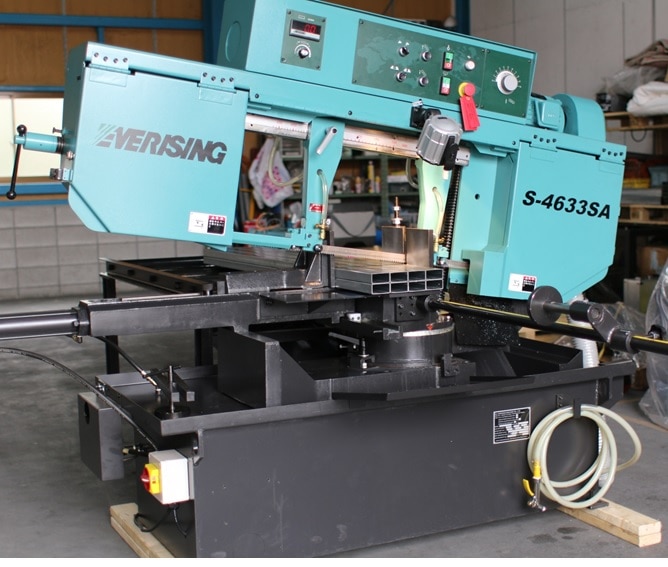
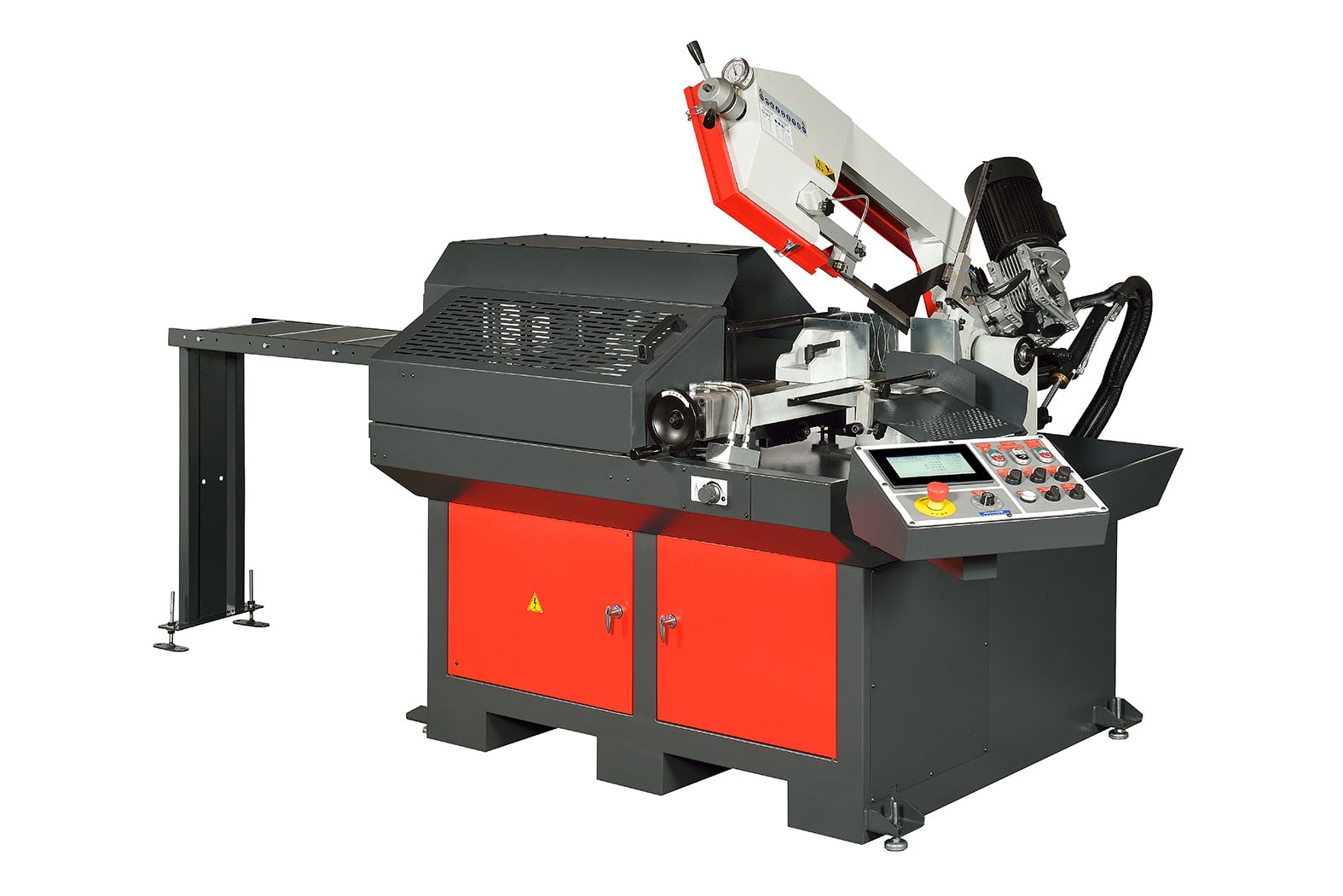
The most commonly used type of stationary band cutting." cutting operation is simple: the saw frame slowly descends from above onto the material, which is securely fixed in a vise, and the saw blade cutting through it.
Horizontal band saw cutting machines include models specifically for straight cutting, as well as models that support single-miter cutting and double-miter cutting. Furthermore, models equipped with automatic feed systems that automatically supply material for continuous cutting are highly effective in mass production.
Vertical type (contour machine)
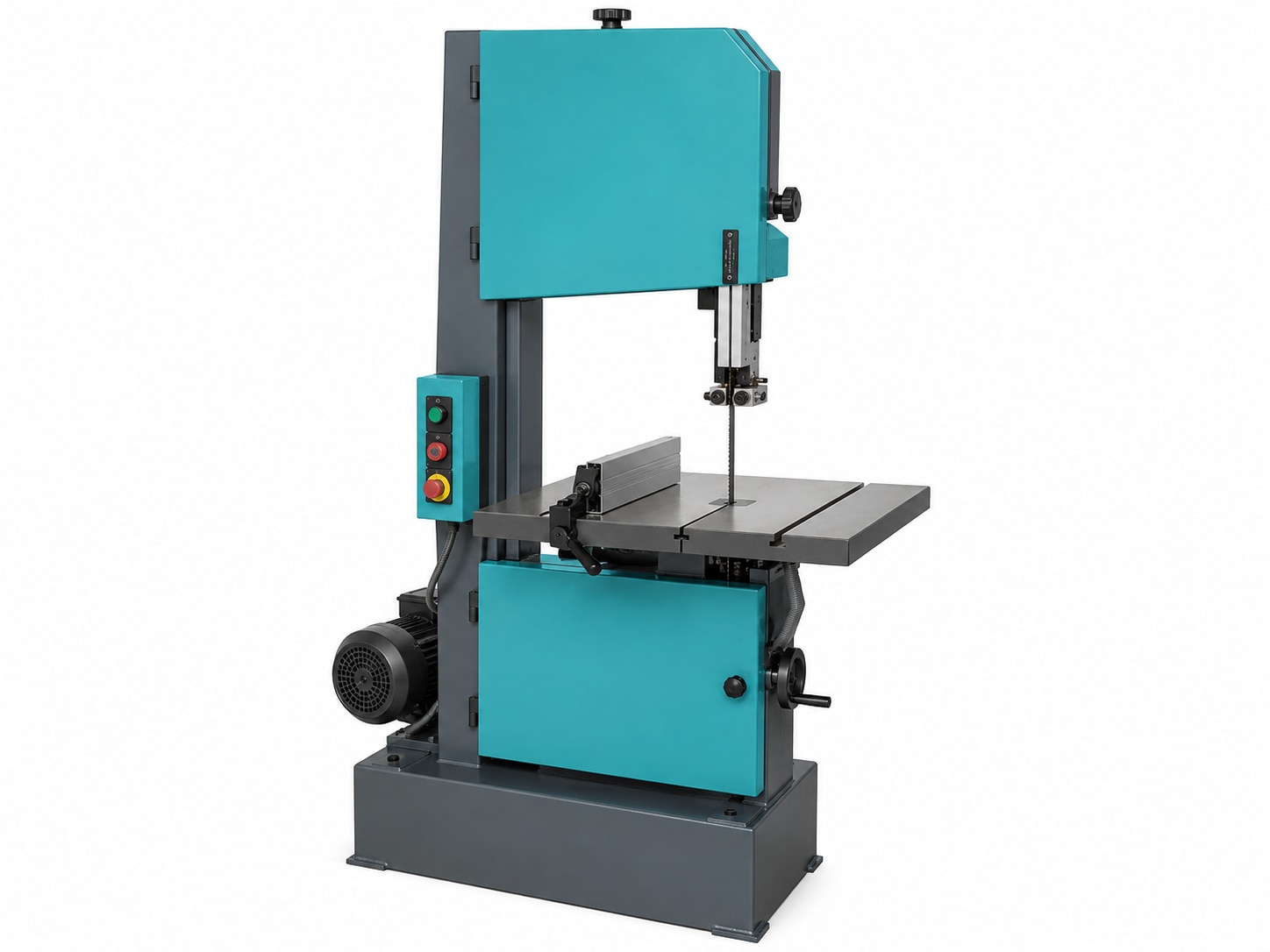
Another major type of stationary device is the "vertical band saw cutting machine," commonly known as the "contour machine." The vertical type features a vertically stretched saw blade, making it suitable not only for linear cutting but also for flexible curve cutting and processing with complex shapes. While horizontal types specialize in processing that determines the 'length' of materials, vertical types are specialized in cutting specific 'shapes' from materials.
Portable
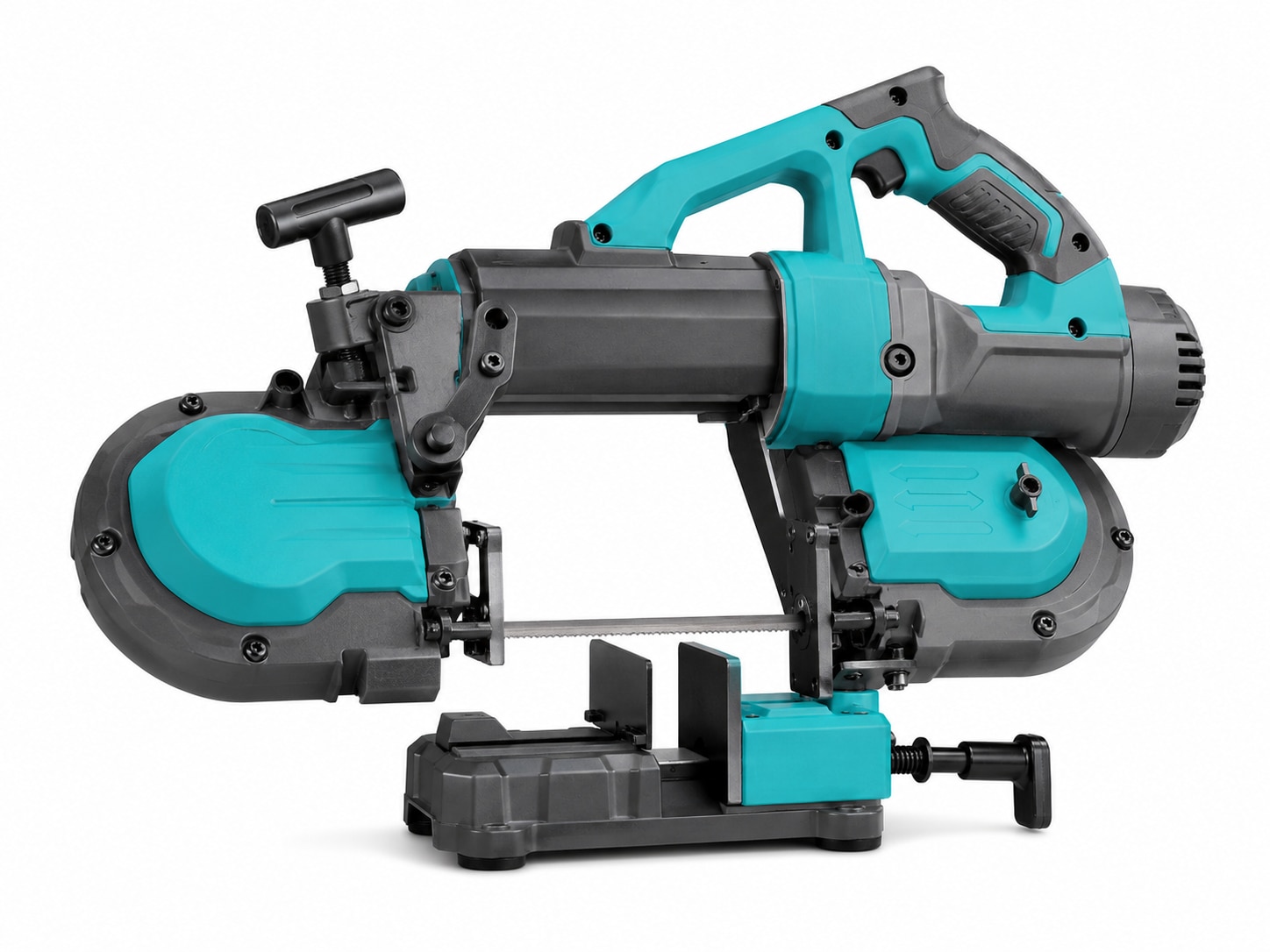
While stationary models are suitable for fixed-location work within factories, portable models prioritize ease of transport and mobility on-site.
These tools are ideal for tasks that are difficult for large machines to perform, such as cutting existing pipes and H-beams, working at heights, or processing in confined spaces. In recent years, cordless models have become the mainstream, allowing for easy operation even in outdoor or temporary work sites where securing a power source is difficult.
How to choose a metal band cutting
In the field, it's often assumed that "increasing cutting speed will increase productivity," but under conditions unsuitable for the material or blade, saw blade life can be significantly reduced, often resulting in increased running costs. When implementing new systems, it's crucial to set conditions based on the material being processed, the quantity cutting, and the required precision.
Choose by production volume
By selecting the optimal band saw cutting machine according to production volume, you can significantly improve work efficiency and cost.
- For small-batch production and high-mix, low-volume production: Semi-automatic systems are recommended. They offer easy setup changes and can handle a wide range of processing needs.
- For mass production and continuous cutting: a model with an automatic feed function is recommended. This automates material feed and cutting, leading to labor savings and increased productivity.
- Consider future production plans: Select cutting capacity and automation features not only for the present, but also with a view to future increases in production and changes in processing methods.
Choose by cutting material
Choosing the right model and blade for the material being cutting will improve cutting quality and extend the life of saw blade.
- Stainless steel: Because it is prone to work hardening, we recommend models that allow you to set appropriate blade speed and feed rate, and highly durable blades.
- Aluminum: Because chips tend to adhere easily, choose a machine that can properly supply cutting fluid and a blade suitable for aluminum.
- Round bars: Because cutting cross-sectional area is large, a machine with high cutting capacity and sufficient rigidity is suitable.
- H-beams, angles, and square pipes: By choosing a model equipped with a stable vise mechanism and feed control, high-quality cutting with reduced bending is possible.
▼If you are cutting aluminum, please also refer to this article.
[Related Article] How to stabilize the quality of aluminum cutting and points to note | Tips for choosing and operating machinery
The correct way to use a band cutting and tips for cutting metal.
Even with a high-performance band cutting, whether you can get the most out of it depends on how you use it on a daily basis. Thorough adherence to correct usage is essential to maximize the machine's performance, extend the life of saw blade, and maintain a safe working environment.
Preparation before cutting
- Ensure that the material's type, shape, and dimensions are within the machine's cutting capacity.
- Select the appropriate blade material, number of teeth, and pitch for the material.
- Thin wood has fine pitch. For thick or solid wood, use a coarse pitch, and ensure that multiple blade tips are applied to the material within the cutting
- Check the blade for chips, cracks, wear, mounting direction, tension, and guide position.
- Securely fasten the materials with a vise, and support long pieces horizontally with rollers or similar equipment.
- Check the type, concentration, quantity, and supply location of the cutting fluid.
- Set the appropriate blade speed and cutting speed according to the material and cross-sectional area.
Key points for achieving high-quality cutting
- Insufficient blade tension or a worn blade can cause the blade to bend or become crooked, so use it in the correct condition.
- Set the blade guide as close to the material as possible to minimize blade wobble.
- Don't cut too quickly, and don't apply excessive force to the blade.
- If the cutting is done too slowly, the blade tip will rub against the material, causing wear and work hardening, so be careful.
- Ensuring that cutting oil is reliably supplied to cutting parts and that chips are discharged
- New blades should be broken in according to the manufacturer's specified conditions.
- If abnormal vibrations, noises, or bending occur, do not force the process to continue; instead, check the blade, guide, and fixing mechanism.
Safety measures when using a band saw cutting machine
Safety measures are not merely rules that must be followed as an obligation; they are also a crucial element in creating an environment where on-site workers can concentrate on their work with peace of mind, ultimately leading to increased productivity. Here are some points to keep in mind for safe use, but when actually using the equipment, please follow the instruction manuals and manufacturer's instructions for each machine to ensure safe operation.
- Before use, please check the instruction manual and ensure that only operators who have received operational training use the product.
- Wear safety glasses, safety shoes, and hearing protection if necessary.
- Wear clothing that prevents sleeves, long hair, accessories, etc. from getting caught in moving parts.
- Always secure the material in a vise and do not cutting while holding it by hand.
- Long materials and heavy objects are supported by rollers, cranes, etc., to prevent them from falling or rolling.
- Do not place your hands or body within the range of motion of the blade, vise, material feed, or discharger while the device is in operation.
- Do not disable safety covers, interlocks, or emergency stop devices.
- Always stop the machine and turn off the main power when changing blades, cleaning chips, removing blockages, or performing inspections to prevent accidental startup.
- Because metal shavings can be sharp and hot, remove them with a brush or specialized tool after stopping operation, and do not touch them with bare hands.
- If any abnormal noises, vibrations, smoke, cutting fluid leaks, or blade abnormalities are detected during operation, immediately stop the operation.
- Promptly clean up any cutting oil or metal shavings from the floor to prevent falls.
- Even during autonomous operation, the system should be used in a way that allows for monitoring for machine malfunctions or material drops.
summary
This article explains the mechanisms, types, selection methods, usage techniques to maximize performance, and safety measures for band cutting, which are essential tools in metal cutting environments. Use this article as a guide to select the perfect band saw for your workplace and create a highly productive environment where everyone can work safely.
Please feel free to contact us! We will propose the optimal band saw cutting machine to suit cutting material and processing requirements.
You can also download our band saw cutting machine catalog for free!